
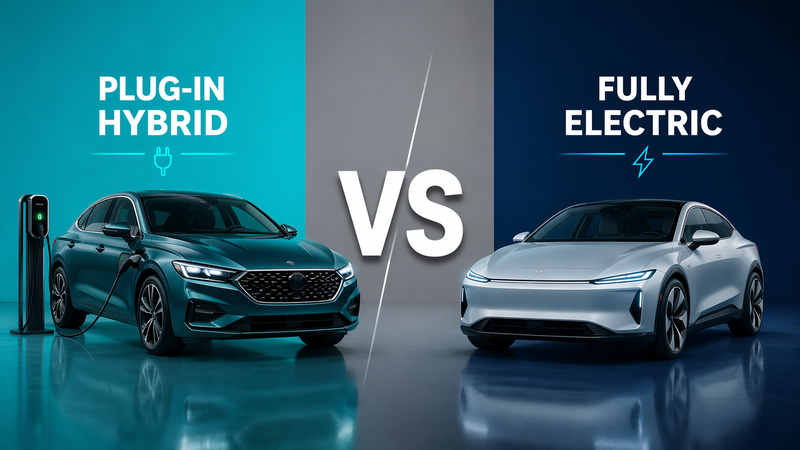

Hybrid vs. Plug-In Hybrid vs. Fully Electric Cars
Choosing between a hybrid, plug-in hybrid, and fully electric car is no longer simply a question of whether you want to use gasoline or electricity. Each powertrain offers a different balance of fuel economy, driving range, charging convenience, maintenance requirements, purchase price, and environmental impact.
A conventional hybrid can improve fuel efficiency without requiring external charging. A plug-in hybrid electric vehicle (PHEV) offers a limited electric driving range alongside a gasoline engine. A fully electric vehicle (EV), also called a battery electric vehicle (BEV), runs entirely on electricity and requires access to charging infrastructure.
The best option depends on how you use your car. A driver who travels short distances in a city and has home charging may benefit most from a fully electric vehicle. Someone who regularly takes long highway trips through areas with limited charging infrastructure may prefer a hybrid or plug-in hybrid. Drivers who want better fuel economy without changing their refueling habits may find a conventional hybrid more practical.
According to the International Energy Agency (IEA), global electric car sales exceeded 20 million in 2025, representing approximately one-quarter of new cars sold worldwide. This growing market makes understanding the differences between electrified powertrains increasingly important for buyers. Source: IEA Global EV Outlook 2026.
This guide compares hybrid vs. plug-in hybrid vs. fully electric cars across technology, running costs, range, charging, maintenance, environmental impact, and everyday usability to help you make an informed decision.
Table of Contents
What Is the Difference Between a Hybrid, Plug-In Hybrid, and Fully Electric Car?
The main difference is how each vehicle stores energy and powers its wheels.
A conventional hybrid combines a gasoline engine with an electric motor and a relatively small battery that recharges while driving. A plug-in hybrid uses a larger battery that can be charged from an external power source, allowing it to cover some journeys using electricity alone. A fully electric car has no gasoline engine and relies entirely on a rechargeable battery and electric motor.
| Feature | Hybrid (HEV) | Plug-in hybrid (PHEV) | Fully electric (BEV) |
| Gasoline engine | Yes | Yes | No |
| Electric motor | Yes | Yes | Yes |
| External charging | No | Yes | Yes |
| Electric-only driving | Limited, depending on model | Yes, within its electric range | Yes, for all driving |
| Gasoline required | Yes | Yes, when the engine is needed | No |
| Tailpipe emissions | Yes, when the engine runs | Yes, when the engine runs | None |
| Dependence on public charging | None | Optional but beneficial | Depends on access to charging |
| Engine servicing | Required | Required | Not applicable |
| Best suited to | Fuel-conscious drivers who do not want to plug in | Drivers who want electric commuting and gasoline backup | Drivers with reliable charging access |
These are general distinctions. Actual performance, electric range, efficiency, and charging capability depend on the specific model, battery size, climate, and driving conditions.
The U.S. Department of Energy’s Alternative Fuels Data Center provides further explanations of hybrid and electric vehicle technology.
1. Hybrid Cars Explained: How Do Conventional Hybrids Work?
A hybrid electric vehicle, or HEV, combines an internal combustion engine with one or more electric motors. The gasoline engine remains an important source of power, while the electric motor helps improve efficiency during acceleration and other driving conditions.
Unlike a plug-in hybrid or fully electric vehicle, a conventional hybrid does not need to be connected to an external charger.
How hybrid technology works
A conventional hybrid uses a combination of engine power, stored electrical energy, and regenerative braking. Regenerative braking allows the electric motor to operate as a generator during deceleration, recovering some energy that would otherwise be lost as heat through the brakes.
The vehicle stores this recovered energy in its battery and uses it later to assist propulsion. Depending on the design, the electric motor may also move the car by itself for short periods at low speeds.
The gasoline engine can recharge the hybrid battery as needed, so drivers do not have to manage charging schedules or locate charging stations.
There are different types of hybrid systems. Mild hybrids use a small electric motor to assist the engine but generally cannot propel the vehicle independently. Full hybrids can sometimes drive on electric power alone for short distances. Buyers should confirm which system a particular model uses rather than assuming all hybrids behave identically.
Advantages of hybrid cars
The biggest advantage of a conventional hybrid is convenience. You refuel at a normal gasoline station and do not need to install a home charger.
Hybrids can be particularly effective in stop-and-go city traffic because regenerative braking recovers energy and the engine may shut off while the car is stopped. Electric motor assistance can also reduce the amount of fuel needed during acceleration.
For drivers who live in apartments, travel frequently, or have unreliable access to charging infrastructure, a hybrid offers a practical way to improve fuel economy without depending on electricity for daily mobility.
Hybrid technology can also be attractive to buyers who are concerned about charging times or long journeys through areas where public charging stations are scarce.
Disadvantages of hybrid cars
A conventional hybrid still consumes gasoline and produces tailpipe emissions when its engine operates. It does not provide the same ability to complete a typical daily commute entirely on externally supplied electricity as a plug-in hybrid or BEV.
Hybrid vehicles also contain both an engine and an electric propulsion system. They therefore retain many conventional engine servicing requirements, although regenerative braking can reduce brake wear.
Another consideration is purchase price. Depending on the market and model, a hybrid may cost more than a comparable gasoline vehicle. Whether the additional expense is recovered through fuel savings depends on annual mileage, fuel prices, and the difference in purchase price.
Who should buy a hybrid car?
A conventional hybrid is worth considering if you:
- Drive regularly in congested cities.
- Want better fuel economy without plugging in.
- Live somewhere with limited charging infrastructure.
- Frequently take long trips and want the convenience of gasoline refueling.
- Prefer a familiar ownership experience with fewer changes to your routine.
A hybrid is often the simplest transition for drivers who want to reduce fuel consumption without making charging part of everyday life.
2. Plug-In Hybrid Cars Explained: How Do PHEVs Work?
A plug-in hybrid electric vehicle combines a gasoline engine, an electric motor, and a rechargeable battery that can be charged using an external power source.
The larger battery allows a PHEV to travel farther on electricity alone than a conventional hybrid. When the battery’s usable electric range is exhausted, the vehicle can switch to gasoline power, depending on the driving conditions and operating mode.
According to the U.S. Department of Energy, many current light-duty PHEVs offer electric-only ranges of approximately 15 to 60 miles or more, depending on the model. Actual range varies with battery capacity, temperature, speed, terrain, and climate-control use. Source: Alternative Fuels Data Center.
How a plug-in hybrid works
A plug-in hybrid can use electricity for daily driving and gasoline for longer journeys. A driver who travels 20 miles to work and back may be able to complete the commute using electricity if the vehicle’s usable range is sufficient and the battery is charged regularly.
For a longer trip, the gasoline engine provides additional driving capability after the battery’s electric range is depleted. Some PHEVs can also combine electric motors and engine power during acceleration or other demanding conditions.
The battery is replenished through an external charger and regenerative braking. Depending on the model, the engine may also contribute energy to the battery.
This flexibility makes a plug-in hybrid a bridge between conventional hybrids and fully electric vehicles. However, its real-world fuel economy depends heavily on whether the owner actually charges it.
Advantages of plug-in hybrid cars
The main advantage is flexibility. Drivers can use electricity for short daily journeys while retaining gasoline backup for long-distance driving.
A PHEV may reduce gasoline consumption substantially when most journeys fall within its electric range and the battery is charged between trips. It can also help drivers become familiar with charging before moving to a fully electric vehicle.
For households that have home charging but occasionally travel through regions with limited public charging, a plug-in hybrid can provide a useful compromise.
Disadvantages of plug-in hybrid cars
Plug-in hybrids have two propulsion systems, which means they retain the maintenance needs of a combustion engine while also carrying a rechargeable battery and electric drive components.
They can also be heavier and more expensive than comparable conventional hybrids. If the owner rarely charges the battery, much of the potential fuel-saving advantage may disappear.
The U.S. Department of Energy notes that a PHEV that is never plugged in may achieve fuel economy similar to that of a comparable conventional hybrid. This is why charging habits matter as much as the vehicle’s advertised electric range. Source: AFDC PHEV guide.
A PHEV is not automatically the cheapest option, either. Its total ownership cost depends on purchase price, charging costs, gasoline consumption, maintenance, and how frequently the electric range is used.
Who should buy a plug-in hybrid?
A PHEV may be suitable if you:
- Have a predictable daily commute that fits within the vehicle’s electric range.
- Can charge at home or at work.
- Occasionally take long trips where charging options are limited.
- Want to reduce gasoline use without relying entirely on charging infrastructure.
- Are prepared to manage two energy sources and maintain a combustion engine.
The central question is whether you will charge it regularly. Without regular charging, a plug-in hybrid may offer less value than expected.
3. Fully Electric Cars Explained: How Do BEVs Work?
A fully electric vehicle, also called a battery electric vehicle or BEV, uses an electric motor powered by a rechargeable battery. It does not have a gasoline engine or fuel tank for propulsion.
The battery is charged by connecting the vehicle to a compatible external power source. During driving, the electric motor converts stored electrical energy into motion. Regenerative braking recovers some energy during deceleration and returns it to the battery.
Because a BEV does not burn gasoline or diesel, it produces no tailpipe exhaust emissions.
How fully electric cars work
A BEV’s main propulsion components include the traction battery, electric motor, power electronics, charging system, and thermal-management equipment. The battery stores energy, while power electronics regulate the electricity supplied to the motor.
Many electric cars can be charged at home overnight or during periods when the vehicle is parked. Public charging stations provide additional options for drivers who need to replenish the battery during the day or on longer journeys.
Charging time varies considerably. A standard household outlet may replenish the battery slowly, while a dedicated AC charger can be much faster. DC fast charging can add substantial range during a stop, although the actual rate depends on the vehicle, charger, battery temperature, and current battery charge level.
Advantages of fully electric cars
One major advantage is energy efficiency. Electric motors convert a large share of the energy they receive into motion, while combustion engines lose substantial energy as heat.
BEVs also have fewer moving drivetrain parts and do not require engine oil changes, spark-plug replacements, or exhaust-system servicing. Regenerative braking can reduce wear on conventional friction brakes.
For drivers who can charge at home, electric vehicles can make everyday energy use convenient. Rather than visiting a fuel station regularly, owners can often begin the day with a charged battery.
Environmental performance is another advantage. A BEV produces no tailpipe emissions, although electricity generation and vehicle manufacturing still have environmental impacts. Its overall emissions advantage depends on the electricity mix, manufacturing process, vehicle efficiency, and lifetime distance driven.
Disadvantages of fully electric cars
A BEV’s practicality depends on access to suitable charging. Drivers without home or workplace charging may need to rely on public stations, which can add time, cost, and inconvenience.
The purchase price can also be higher than that of a comparable conventional vehicle, although prices vary widely by model and market. Battery replacement outside warranty can be expensive, so battery warranty terms, service support, and repair availability deserve attention when buying a new or used EV.
Driving range is affected by speed, temperature, terrain, vehicle load, and heating or air-conditioning use. A car that comfortably meets a driver’s needs in mild weather may provide less usable range during extreme heat or cold.
Long-distance travel also requires more planning than driving a gasoline vehicle in places where charging stations are sparse. This limitation is particularly important for drivers who regularly travel through rural areas or across regions with inconsistent charging coverage.
Who should buy a fully electric car?
A BEV is worth considering if you:
- Have access to reliable home or workplace charging.
- Drive predictable daily distances.
- Want to eliminate gasoline use.
- Prefer lower routine drivetrain maintenance.
- Have access to suitable public charging for occasional longer journeys.
- Plan to keep the car long enough to evaluate its total ownership cost.
For drivers with convenient charging and suitable travel patterns, a fully electric vehicle can offer a particularly straightforward daily driving experience.
4. Hybrid vs. Plug-In Hybrid vs. Electric Cars: Cost Comparison
The purchase price is only one part of vehicle ownership. A meaningful comparison should include energy costs, routine maintenance, repairs, charging equipment, insurance, taxes, financing, resale value, and incentives where available.
The cheapest car to buy is not necessarily the cheapest to own.
Purchase price
Conventional hybrids often cost more than comparable gasoline vehicles because of their electric motors, batteries, and power electronics. Plug-in hybrids may cost more because they have larger batteries and charging hardware.
Fully electric vehicles have larger traction batteries and can carry a higher upfront price in some segments. However, prices differ considerably across vehicle classes, and a smaller electric car may cost less than a larger hybrid or premium gasoline vehicle.
Always compare vehicles of similar size, safety equipment, performance, and features. Comparing a premium electric SUV with an entry-level hybrid sedan will not produce a meaningful cost comparison.
Fuel and electricity costs
A hybrid uses gasoline, so its running cost depends on fuel economy and local fuel prices.
A PHEV uses a combination of electricity and gasoline. Its energy cost depends on the share of driving completed in electric mode, the cost of electricity, and how efficiently it operates when the engine is running.
A BEV uses electricity, so the main energy cost is the amount of electricity required per kilometre or mile multiplied by the price paid for that electricity.
A simple comparison can be made using these formulas:
- Hybrid fuel cost per distance = fuel consumed × fuel price.
- PHEV energy cost = electricity consumed × electricity price, plus gasoline consumed × fuel price.
- BEV energy cost = electricity consumed × electricity price.
For an accurate comparison, use real-world consumption data and include charging losses where possible. Public fast charging can cost more than home charging, so a BEV’s running cost depends partly on where it is charged.
The U.S. Department of Energy’s Alternative Fuels Data Center provides information on electricity as a vehicle fuel and links to tools for estimating local costs.
Maintenance and repair costs
Hybrids and PHEVs still have combustion engines, so they need appropriate engine servicing and may require repairs to engine-related components. Their electric systems can reduce fuel consumption and brake wear, but they do not remove all conventional maintenance requirements.
Fully electric vehicles generally require less routine drivetrain maintenance because they have fewer moving parts and no engine oil, spark plugs, or exhaust system. Tires, suspension components, cabin filters, coolant systems where fitted, and brakes still require inspection or servicing as specified by the manufacturer.
A U.S. Department of Energy analysis published in 2021 estimated scheduled maintenance costs of approximately 6.1 cents per mile for battery electric vehicles, compared with 10.1 cents per mile for conventional internal-combustion vehicles. These are historical U.S. estimates, not current universal prices, and actual costs vary by model, region, labor rates, and maintenance schedule. Source: U.S. Department of Energy.
Battery replacement and warranties
Battery health is particularly important when purchasing a used PHEV or BEV. Battery capacity may decline over time, and the degree of degradation depends on chemistry, temperature exposure, charging practices, age, and use.
Before purchasing a used electrified vehicle, review the remaining battery warranty, service history, diagnostic information, and any manufacturer-specific battery health reports. A vehicle’s displayed range alone does not provide a complete picture of battery condition.
Do not assume every vehicle has the same warranty. Coverage limits, time periods, mileage thresholds, and minimum capacity guarantees differ by manufacturer and model.
5. Driving Range and Charging: Which Is More Convenient?
Range and charging are among the most important differences between these powertrains.
A conventional hybrid can continue travelling as long as it has gasoline and access to fuel stations. It does not require external charging, making it particularly convenient in regions with limited charging infrastructure.
A plug-in hybrid offers an electric-only range for shorter journeys, followed by gasoline operation when required. Its overall journey range depends on both battery energy and fuel-tank capacity.
A fully electric vehicle relies on its battery for all propulsion. Its practical range depends on battery capacity, efficiency, driving conditions, and the availability of charging during the journey.
Home charging versus public charging
Home charging is often the most convenient arrangement for BEV and PHEV owners. A driver can plug in while the car is parked and begin the next day with additional battery charge.
However, not every home electrical installation is suitable for every charging arrangement. Before installing a charger, have the electrical supply and installation assessed by a qualified professional, and confirm that the equipment complies with local requirements.
Public charging becomes more important for apartment residents, drivers without a private parking space, and people who regularly travel long distances. Before buying a BEV, check the charging stations along the routes you actually use, not just the number of chargers shown on a national map.
Range in hot and cold weather
Extreme temperatures can reduce usable driving range because the vehicle may need additional energy to regulate battery temperature and maintain cabin comfort. High-speed driving, hills, heavy loads, and frequent acceleration can also increase energy consumption.
This matters in hot climates, where air-conditioning use can increase energy demand. Buyers should assess range using realistic local conditions and leave a reasonable margin for unexpected trips.
For a PHEV, these factors may reduce the distance covered before the gasoline engine starts. For a BEV, they can mean charging more frequently than expected.
6. Environmental Impact: Which Vehicle Is Greener?
A vehicle’s environmental impact should be evaluated across its life cycle, not only by looking at tailpipe emissions.
Manufacturing a vehicle requires energy and raw materials. Battery production adds environmental impacts, while gasoline and diesel vehicles produce emissions during fuel extraction, refining, distribution, and combustion. Electric vehicles also have indirect emissions associated with electricity generation.
Tailpipe emissions
Conventional hybrids produce exhaust emissions when the combustion engine runs. Plug-in hybrids produce no tailpipe emissions while operating in electric-only mode, but they emit pollutants when the engine is running.
Fully electric vehicles produce no tailpipe emissions during driving. However, their total climate impact depends partly on how the electricity used to charge them is generated.
What life-cycle research shows
A July 2025 analysis by the International Council on Clean Transportation (ICCT) compared the life-cycle greenhouse gas emissions of passenger cars sold in the European Union, including vehicle and battery manufacturing, energy production, driving, maintenance, and recycling.
For the study’s medium-sized vehicles and assumptions, battery electric cars using the projected EU electricity mix were estimated to have approximately 73% lower life-cycle greenhouse gas emissions than comparable gasoline cars. The study estimated reductions of approximately 20% for conventional hybrids and 30% for plug-in hybrids compared with gasoline vehicles.
These figures are specific to the European Union’s vehicle mix and electricity assumptions; they should not be applied directly to every country or model. Source: ICCT, July 2025.
The key lesson is that battery electric vehicles can offer substantial life-cycle emissions reductions, while hybrids and plug-in hybrids can also reduce emissions compared with conventional gasoline vehicles. For PHEVs, the actual benefit depends heavily on how much driving is completed using electricity.
A plug-in hybrid that is charged regularly and used mostly for short electric journeys can perform very differently from one that is rarely plugged in.
7. Which Vehicle Is Best for City Driving?
For urban driving, all three powertrains can offer benefits, but the best choice depends on parking, traffic, daily distance, and charging access.
A conventional hybrid is particularly practical for congested cities because it can recover energy through regenerative braking and does not require charging infrastructure.
A plug-in hybrid may be attractive for a city commuter who can charge at home. If daily journeys fall within its electric range, it may complete much of the commute without using gasoline.
A fully electric vehicle is often an excellent choice for city drivers who can charge conveniently. It offers quiet operation, responsive acceleration, and no tailpipe emissions.
However, apartment residents without reliable charging may find a hybrid easier to manage. Before choosing a BEV or PHEV for city use, consider where the car will be parked overnight and how charging will fit into the weekly routine.
8. Which Vehicle Is Best for Long-Distance Travel?
For drivers who frequently take long journeys, the decision depends on the routes, charging network, and availability of fuel stations.
A conventional hybrid offers familiar refueling convenience and does not require charging stops. This can be a major advantage in areas where charging infrastructure is limited.
A plug-in hybrid combines electric driving for some journeys with gasoline backup for longer trips. However, its electric range is finite, and it still requires fuel when the engine is used.
A fully electric car can be suitable for long-distance travel when reliable fast charging is available along the route. Planning stops, checking charger compatibility, and allowing time for charging are important parts of the journey.
For frequent long-distance drivers, compare the actual travel time rather than looking at range alone. Consider the length of charging stops, charging reliability, traffic, and the distance between available stations.
9. What Should You Consider Before Buying a Used Hybrid, PHEV, or EV?
Used electrified vehicles can provide value, but buyers should examine the condition of their electrical and mechanical systems carefully.
For a conventional hybrid, check the maintenance history, hybrid system warning lights, engine condition, transmission operation, and battery health where diagnostic testing is available.
For a PHEV, assess both the engine and the rechargeable battery. Confirm that the charging port works, the vehicle charges correctly, and the battery can provide a reasonable electric range for its age and condition.
For a BEV, examine battery health, charging performance, remaining warranty, service history, and evidence of accident damage or repairs to high-voltage components. A professional inspection by a technician qualified to work on the particular vehicle is advisable.
Also check local parts availability, dealer support, software updates, and repair options. These factors can materially affect ownership costs, particularly in markets where some models are imported or have limited authorized service coverage.
10. How to Choose the Right Powertrain for Your Driving Habits
Rather than choosing based on trends, start with a realistic picture of your driving.
Estimate how many kilometres or miles you travel each day, how often you make long journeys, where the vehicle will be parked, and whether home or workplace charging is practical. Then compare the total ownership cost of vehicles that meet your needs.
A hybrid is often the most convenient option for drivers who want improved fuel economy but do not want to plug in. A plug-in hybrid is more compelling for people who can charge regularly and whose daily journeys fit within the electric range. A fully electric car is especially attractive for drivers with reliable charging access who want to eliminate gasoline use and reduce routine drivetrain maintenance.
Before deciding, calculate the cost of energy using local fuel and electricity prices. Add the purchase price, financing, insurance, servicing, taxes, charging installation, and likely resale value. If you are buying a used vehicle, include battery health and warranty coverage in your assessment.
The right vehicle is the one that meets your driving needs reliably at a cost you can justify—not necessarily the one with the largest battery or the highest advertised fuel economy.
Conclusion
The comparison between hybrid vs. plug-in hybrid vs. fully electric cars comes down to how each powertrain fits your driving habits and charging access.
Conventional hybrids improve fuel efficiency while preserving gasoline refueling convenience. Plug-in hybrids offer electric driving for shorter journeys and a gasoline engine for longer trips, but their benefits depend on regular charging. Fully electric vehicles eliminate tailpipe emissions and generally require less routine drivetrain maintenance, but they depend on suitable charging infrastructure and realistic range planning.
There is no single best choice for every driver. Evaluate the vehicles available in your market, compare their real-world energy consumption and ownership costs, and consider the reliability of local service and charging networks.
For drivers who can charge conveniently, a BEV may deliver the strongest combination of everyday efficiency and reduced life-cycle emissions. For drivers who cannot charge reliably, a conventional hybrid may be the more practical solution. A PHEV can occupy the middle ground when its electric range matches daily travel and the owner charges consistently.
Frequently Asked Questions
1. What is the main difference between a hybrid and a plug-in hybrid?
A conventional hybrid charges its small battery through regenerative braking and the engine; it cannot normally be plugged into an external charger. A plug-in hybrid has a larger battery that can be externally charged and can travel farther on electricity alone before relying on gasoline.
2. Is a plug-in hybrid better than a fully electric car?
Neither is universally better. A plug-in hybrid may suit drivers who can charge regularly but often travel through areas with limited charging infrastructure. A fully electric car may be better for drivers with reliable charging access who want to eliminate gasoline use and reduce routine drivetrain maintenance.
3. Can a hybrid car run on electricity alone?
Some full hybrids can drive short distances at low speeds using electric power alone, depending on the model and battery charge. Mild hybrids generally cannot propel the car using only electricity. A conventional hybrid still relies on gasoline for its overall operation.
4. Do plug-in hybrid cars need to be charged every day?
Not every PHEV must be charged daily, but frequent charging is important if you want to maximize electric driving and reduce gasoline use. If you rarely charge the battery, the vehicle may operate much like a conventional hybrid while carrying the extra weight of its plug-in system.
5. Are fully electric cars cheaper to maintain?
Fully electric cars generally have lower routine drivetrain maintenance needs because they do not have combustion engines, engine oil, spark plugs, or exhaust systems. However, tires, suspension, brakes, cooling systems where fitted, and other components still require maintenance. Actual repair costs vary by model and region.
6. Do electric cars have enough range for long journeys?
Many electric cars can handle long journeys, but suitability depends on the vehicle’s real-world range and the charging infrastructure along the route. Check charger availability, compatibility, reliability, and charging time before buying a car for frequent long-distance travel.
7. Which type of car is best for city driving?
A hybrid is convenient in cities without charging access. A plug-in hybrid can be efficient for short commutes if charged regularly, while a fully electric car can be an excellent city vehicle for drivers with convenient home or workplace charging.
8. Are electric cars better for the environment than hybrids?
Life-cycle research generally finds that battery electric vehicles produce lower greenhouse gas emissions than comparable gasoline vehicles and hybrids in many markets. The size of the benefit depends on battery manufacturing, electricity generation, vehicle efficiency, and lifetime use. A plug-in hybrid’s emissions also depend on how frequently it is charged.
9. Is a used electric car worth buying?
A used electric car may offer good value if its battery is healthy, the price reflects its age and condition, and charging and service support are available. Review battery warranty coverage, charging performance, service records, and the cost of repairs before purchasing.
10. Which is the best option if I cannot charge at home?
A conventional hybrid is often the simplest choice because it does not depend on external charging. A PHEV may still make sense if workplace or public charging is reliable and convenient. A fully electric vehicle is less convenient if you have no dependable charging option.
11. Does hot weather affect electric car range?
Yes. High temperatures and air-conditioning use can increase energy consumption, while battery thermal management may also require energy. Actual range depends on the vehicle, temperature, speed, terrain, and driving habits. Use real-world range estimates for your local climate rather than relying exclusively on official test figures.
12. What is the best way to compare the total cost of ownership?
Compare the purchase price, financing, fuel or electricity, maintenance, insurance, taxes, charging equipment, expected repairs, and resale value over the period you intend to own the vehicle. Use local energy prices and realistic consumption figures to make the comparison meaningful.
if you are looking to write about automotive You can search for us with the query “Write for Us Automotive” in search engines.
For more updates and the latest Automotive news, visit StyleInFlux.