
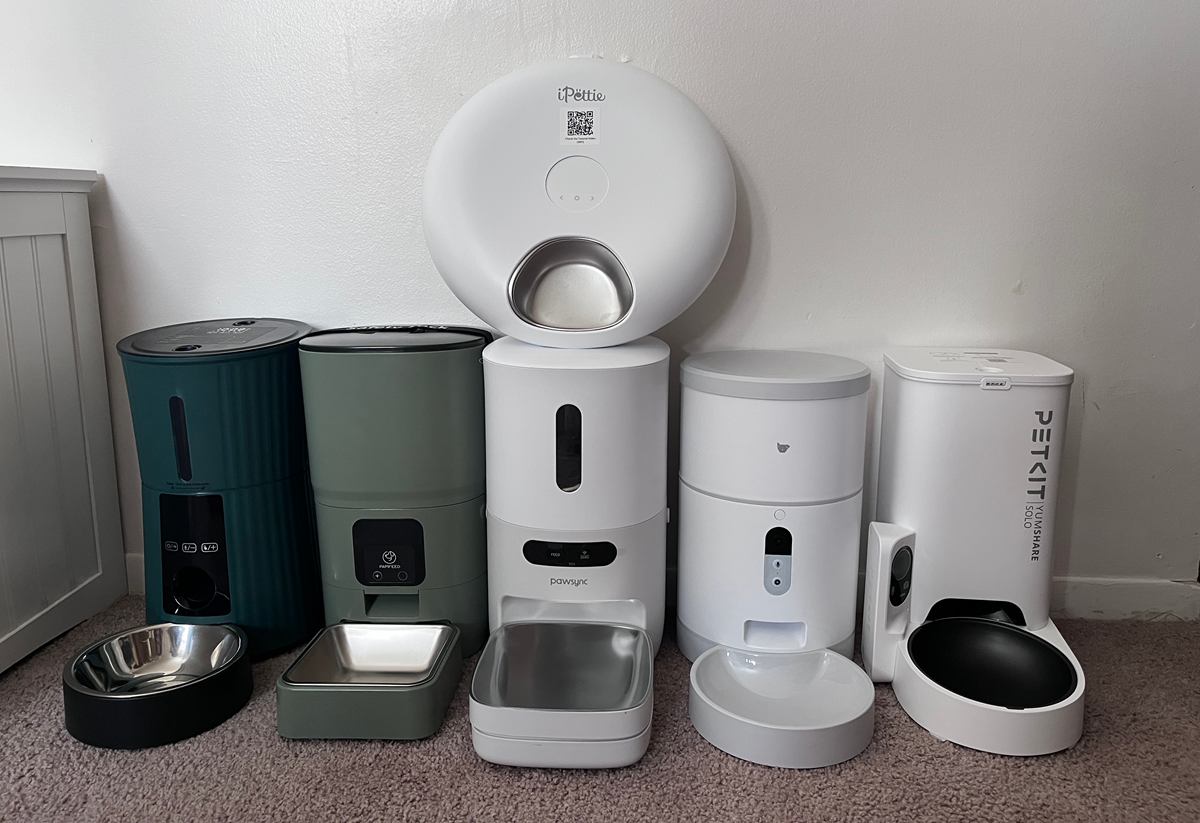

Managing feeding time in a home with multiple cats can become surprisingly complicated. One cat may finish its food within seconds and immediately approach another cat’s bowl. A senior cat may need smaller meals, while a younger cat needs a different portion size. Some cats eat wet food, others prefer dry kibble, and certain pets require prescription diets that should not be shared.
An automatic cat feeder can make feeding routines more organised, but not every model is designed to manage the challenges of a multi-cat household. A standard automatic feeder dispenses food according to a schedule. It does not necessarily recognise individual cats, prevent food stealing or ensure that each pet receives the correct amount.
This distinction is important when choosing the best automatic cat feeder for multiple cats. Some households need a dual-bowl feeder that divides food between two eating areas. Others need microchip technology that opens a feeding compartment only for an authorised cat. Homes with several cats on the same diet may benefit from multiple scheduled feeders, while households with different dietary requirements may need individually controlled feeding stations.
This guide compares the most useful types of automatic cat feeders, examines popular models, explains which features matter and provides practical advice for selecting a safe feeding arrangement. It also covers portion control, wet-food storage, cleaning, power backup and the limitations of automatic feeding systems.
Table of Contents
1. What Is the Best Automatic Cat Feeder for Multiple Cats?
The best automatic cat feeder depends on how your cats eat, whether they share the same food and whether one cat regularly steals another’s meals.
For households where cats need separate diets, a microchip-activated feeder is generally more suitable than a basic timed dispenser. It recognises an authorised pet and controls access to its food. For two cats eating the same dry food, a dual-bowl automatic feeder may be a more affordable option because it can distribute scheduled portions into two separate bowls.
Here are five products and product categories worth comparing:
| Feeder | Best suited to | Food type | Main advantage |
| SureFeed Microchip Pet Feeder | Cats with different diets | Wet and dry | Restricts access using an implanted microchip or compatible RFID tag |
| PETLIBRO One RFID | Cats that need individual dry-food access | Dry | RFID-based access control and scheduled feeding |
| OneIsAll Two-Bowl Automatic Feeder | Two cats eating the same food | Dry | Distributes food into two bowls |
| PETLIBRO Granary WiFi | Scheduled feeding for shared food arrangements | Dry | App-based meal scheduling and monitoring |
| Cat Mate C500 | Scheduled small meals | Wet and dry, subject to food-care requirements | Multiple covered food compartments |
These products solve different problems, so they should not be treated as interchangeable. In particular, a two-bowl feeder does not automatically prevent one cat from eating both portions.
2. Best Automatic Cat Feeders for Multiple Cats: Detailed Reviews
2.1 SureFeed Microchip Pet Feeder – Best for Cats with Different Diets
The SureFeed Microchip Pet Feeder is one of the most relevant options for multi-cat households where food stealing is a regular problem.
Unlike a conventional automatic feeder, it uses an identification system to determine which pet can access the food. The unit can recognise a cat’s implanted identification microchip or a compatible Sure Petcare RFID collar tag.
When an authorised cat approaches, the lid opens to provide access to the food. If an unauthorised pet approaches, the feeder keeps the food covered.
This makes it particularly useful when one cat needs a prescription diet, a controlled feeding plan or a different food formula from the other cats in the household.
According to the manufacturer, the feeder:
- Works with common pet identification microchips and compatible RFID collar tags.
- Stores up to 32 pet identities.
- Supports wet and dry food.
- Has a bowl capacity of 400 ml, or space for two pouches of wet food.
- Uses four C-cell batteries, with a manufacturer-stated battery life of approximately six months under normal use.
- Includes a training mode to help pets become comfortable with the moving lid.
- Comes with a three-year manufacturer’s warranty in the US product listing.
The feeder also includes a sealed bowl design intended to help keep food fresher and reduce access by flies.
Why it is useful for multiple cats
Imagine a household with two cats. The first cat needs a weight-management diet, while the second eats a standard adult maintenance food. A normal automatic feeder could dispense both portions, but it would not necessarily stop the wrong cat from eating them.
A microchip feeder addresses that access problem. Each cat can have its own feeding arrangement, reducing opportunities for food stealing.
Limitations to consider
The standard SureFeed Microchip Pet Feeder is not a large-capacity hopper that automatically dispenses several scheduled meals throughout the day. It controls access to food placed in its bowl.
Owners must still measure and replenish the food. The unit also needs batteries, and cats unfamiliar with a moving lid may require gradual training.
For a household with three cats on three separate diets, individual feeding arrangements may be necessary rather than assuming one unit can manage every meal.
Manufacturer information: Sure Petcare Microchip Pet Feeder.
2.2 PETLIBRO One RFID – Best for Individual Dry-Food Access
The PETLIBRO One RFID feeder is designed for households that need to control access to scheduled dry-food portions.
It uses an RFID collar tag rather than relying exclusively on a cat’s implanted identification microchip. The feeder recognises an authorised tag and controls access to the food compartment.
This is an important distinction when comparing it with a microchip-only system. A cat needs to wear the compatible collar tag, so owners should consider whether their pets comfortably tolerate collars.
The model is designed for individual feeding arrangements and is particularly relevant when one cat tends to eat another cat’s dry food.
Why it is useful
A conventional timed feeder may release food at exactly the right time, but it cannot identify which cat is eating. RFID access control adds an additional layer of separation.
For example, a household with two cats may assign each cat its own feeder and RFID tag. The owner can then manage each feeding schedule separately rather than relying on a shared food dispenser.
This can help when cats have different portion requirements or eating routines.
Limitations to consider
The PETLIBRO One RFID is a dry-food solution. It should not be treated as a wet-food feeder.
The collar tag is also a practical consideration. Owners need to ensure that the tag remains attached and that the collar is appropriately fitted. A tag-based system should not be confused with a reader that directly recognises every implanted pet microchip.
Check the exact model and current manufacturer instructions before purchasing, particularly if you have several cats and need multiple individual profiles.
Product information and comparisons: PETLIBRO.
2.3 OneIsAll Two-Bowl Automatic Cat Feeder – Best for Two Cats Sharing the Same Food
A dual-bowl automatic feeder can be a practical choice when two cats eat the same type of food and have broadly compatible feeding schedules.
The OneIsAll two-bowl automatic feeder is an example of this category. It uses a shared food hopper and distributes scheduled dry-food portions into two separate bowls.
This arrangement can be convenient for households where both cats eat the same kibble and do not compete aggressively for food.
Instead of buying two conventional feeders, owners can use one dispensing unit with two feeding outlets.
Why it is useful
A two-bowl feeder reduces the amount of equipment needed and can make scheduled feeding easier to manage.
It may be suitable when:
- Both cats eat the same food.
- Their meal schedules are similar.
- They can comfortably eat near each other.
- Neither cat regularly steals food from the other.
- Their portion requirements can be managed through the feeder’s dispensing arrangement.
Important limitation: two bowls do not mean individual access control
This is the most important point to understand before purchasing a dual-bowl automatic feeder.
A dual-bowl design does not necessarily recognise individual cats. If one cat finishes its portion and moves to the second bowl, the feeder may not prevent it from eating the other cat’s food.
It also may not provide independent meal scheduling or portion settings for each bowl.
Therefore, a dual-bowl feeder is best considered a food-distribution solution rather than a secure individual feeding system.
2.4 PETLIBRO Granary WiFi Automatic Feeder – Best for App-Based Scheduling
The PETLIBRO Granary WiFi is a scheduled dry-food dispenser that offers app-based feeding controls.
Its appeal is convenience. Owners can configure meal times and portions, monitor feeding schedules and receive relevant device notifications, depending on the model and app configuration.
The Granary range includes different versions, so specifications such as hopper capacity, number of daily meals, backup power and connectivity should be checked against the exact product number.
Why it is useful for multi-cat households
A smart automatic feeder can be useful when several cats follow similar meal schedules.
For example, an owner who works outside the home may want breakfast and afternoon meals dispensed automatically. App-based scheduling can make adjustments easier than manually setting a conventional timer.
However, the feeder is not an individual cat identification system. If several cats have access to the same bowl, the owner cannot assume that each animal receives its assigned portion.
A practical arrangement may involve placing separate scheduled feeders in different locations, provided the cats cannot easily access each other’s food.
Limitations to consider
The Granary is designed for dry food. Owners should check kibble size compatibility, the dispensing mechanism, backup-power arrangements and the cleaning instructions.
Wi-Fi connectivity is also not a substitute for reliable mechanical operation. Test the feeder locally and confirm what happens if the internet connection or electricity supply is interrupted.
Product information: PETLIBRO Automatic Feeders.
2.5 Cat Mate C500 – Best for Scheduled Compartment Feeding
The Cat Mate C500 uses covered food compartments rather than a large hopper that dispenses kibble through a rotating mechanism.
Its five-compartment design can be useful when an owner wants to prepare several meals in advance.
The feeder is commonly used for both wet and dry food, subject to the manufacturer’s food-storage instructions and the surrounding temperature.
This design is different from a microchip feeder. It does not identify which cat is eating. Its purpose is to make prepared portions available according to a schedule.
Why it is useful
Compartment feeders can help with controlled meal preparation. The owner can measure portions in advance and assign food to specific time slots.
This may be useful for cats that need smaller, more frequent meals or households where an owner wants to prepare food before leaving home.
Limitations to consider
A shared compartment feeder does not guarantee that each cat receives its own portion. If two cats can reach the same compartment, one may consume more than intended.
Wet food also requires appropriate handling. Do not assume that a covered compartment keeps perishable food safe indefinitely. Follow the manufacturer’s instructions for ice packs, food type, maximum storage time and room temperature.
Product information: Cat Mate.
3. How to Choose an Automatic Cat Feeder for Two or More Cats
The number of cats in your home is only one factor when choosing an automatic feeder. Their feeding behaviour and dietary requirements are often more important.
A household with four cats eating the same dry food may be easier to manage than a household with two cats that require different prescription diets.
Consider Whether Your Cats Share the Same Food
Start by identifying whether all your cats can safely eat the same food.
If they have similar nutritional requirements, a shared scheduled feeder may be practical, provided they do not compete for access.
However, cats may require different diets because of age, body condition, medical needs or veterinary recommendations.
If one cat requires a specific food, the feeder must help prevent the other cats from eating it.
In this situation, an individually controlled microchip or RFID feeder is generally more appropriate.
Check Portion Control
Portion control is particularly important in households where cats have different body weights or energy requirements.
An automatic feeder should allow owners to measure and dispense an appropriate amount rather than relying on an arbitrary number of meals.
For accurate feeding, check whether the manufacturer specifies portions in grams or only in approximate dispensing units.
A measured gram weight is generally more useful because kibble size and density can vary between brands.
The Association of American Feed Control Officials (AAFCO) provides information on pet-food labelling and nutritional adequacy, while veterinary professionals can help determine how much food an individual cat should receive.
Do not assume that the same portion is appropriate for every cat.
Evaluate the Feeding Capacity
Feeder capacity matters when several cats use the same unit, but a larger hopper is not automatically better.
For example, a 5-litre hopper may hold a substantial quantity of dry food, but the number of days it lasts depends on the food’s density and the combined daily consumption of the cats.
A useful planning calculation is:
Daily household food requirement = Sum of each cat’s daily food allowance.
For example, if three cats each receive 50 grams per day:
50 g + 50 g + 50 g = 150 g per day.
If the hopper contains 1,500 grams of food, its theoretical capacity would cover:
1,500 g ÷ 150 g = 10 days.
This is a mathematical illustration, not a guarantee of actual feeder capacity. The real amount depends on kibble density, hopper design, dispensing accuracy and food remaining in the mechanism.
Look for Reliable Power Backup
Automatic feeders that rely on electricity may stop dispensing food during a power interruption unless they include an appropriate backup system.
Check whether the model supports batteries, whether batteries are included and whether the programmed schedule continues during a power failure.
Some models use batteries as emergency backup rather than as their primary power source.
Owners should also test the feeder after a power interruption rather than assuming that its schedule will resume correctly.
Consider Cleaning and Food Hygiene
Food residue can accumulate around dispensing outlets, bowl edges and removable trays.
A feeder that is difficult to dismantle may become inconvenient to clean regularly.
Look for removable bowls, accessible food-contact surfaces and clear manufacturer cleaning instructions.
Stainless-steel bowls can be useful because they are generally easy to clean, but the quality and construction of the entire feeder still matter.
Avoid assuming that every component is dishwasher-safe. Check the instructions before placing parts in a dishwasher or submerging an electronic unit.
4. Microchip Feeders vs RFID Feeders vs Standard Automatic Feeders
These three categories are often confused, but they provide different levels of control.
Microchip-Activated Feeders
A microchip feeder recognises a pet’s implanted identification microchip or a compatible RFID tag.
The feeder opens only for an authorised animal.
This is useful when one cat needs a specific food or another cat repeatedly steals its meals.
The SureFeed Microchip Pet Feeder is an example of this category. Its manufacturer states that it can store up to 32 pet identities.
RFID Collar-Tag Feeders
RFID feeders recognise a compatible electronic tag attached to a pet’s collar.
They can provide individual access control without requiring the feeder to read the implanted microchip.
The PETLIBRO One RFID is an example.
The main practical consideration is that the cat must wear the correct tag. If the tag is lost or the collar is removed, the feeder may not recognise the pet.
Standard Timed Automatic Feeders
Standard automatic feeders release food at programmed times.
They are useful for routine feeding, but they generally cannot identify which animal is eating.
A household with two cats may schedule two portions, but that does not guarantee that both cats receive one portion each.
Comparison Table
| Feature | Microchip feeder | RFID collar feeder | Standard timed feeder |
| Identifies individual pets | Yes, compatible chips/tags | Yes, compatible tags | No |
| Scheduled food dispensing | Usually access-controlled rather than hopper-based | Model-dependent | Yes |
| Wet-food suitability | Many models support wet food | Usually model-dependent; check product | Depends on design |
| Prevents unauthorised access | Yes, when configured correctly | Yes, when configured correctly | No |
| Suitable for different diets | Very useful | Useful | Only with physical separation |
| Requires a collar | Not if using an implanted microchip | Yes | No |
For households where cats have different diets, individual access control is often more important than a large hopper or a smartphone application.
5. Why Separate Feeding Stations Matter in Multi-Cat Homes
Automatic feeders do not solve every feeding problem. The location and arrangement of feeding stations also affect how comfortably cats eat.
The 2024 AAFP intercal tension guidelines recommend providing multiple, visually separated food and water stations. They also identify microchip-activated feeders as a useful option when feeding separation is required.
The earlier AAFP and ISFM environmental needs guidelines also recommend separate feeding stations for cats in multi-cat households.
These recommendations reflect an important behavioural consideration: cats do not necessarily prefer to eat beside one another, even when they live peacefully in the same home.
Preventing Food Stealing
Food stealing often occurs when one cat eats quickly and then moves towards another cat’s bowl.
A standard automatic feeder may dispense the correct amount, but it cannot necessarily prevent this behaviour.
Microchip feeders, separate rooms and visual barriers can help reduce competition.
Reducing Feeding Stress
Some cats become uncomfortable when another animal approaches while they are eating.
A quiet feeding location with a clear escape route can help a cat eat without feeling pressured.
Where possible, place feeding stations far enough apart that one cat cannot easily guard both.
Supporting Individual Dietary Needs
Cats may need different food because of weight-management plans, age, allergies or medical conditions.
A separate feeding station helps owners monitor whether the correct cat is consuming the intended food.
For cats receiving veterinary-prescribed diets, ask the veterinarian whether other household pets can safely consume that food before allowing shared access.
6. Automatic Feeders for Wet Food vs Dry Food
Food type is one of the most important considerations when buying an automatic cat feeder.
Many hopper-style feeders are designed specifically for dry kibble. Wet-food feeders generally use covered compartments or specialised cooling arrangements.
Automatic Feeders for Dry Cat Food
Dry-food feeders usually store kibble in a hopper and release measured portions through a dispensing mechanism.
Their advantages include:
- Larger storage capacity.
- Easier scheduling of multiple meals.
- Less need to prepare each meal manually.
- Compatibility with some smart-app systems.
- Convenience for households using dry food as their main diet.
However, kibble size and shape can affect dispensing performance. Owners should check the manufacturer’s recommended food dimensions and test the feeder with the actual food being used.
Automatic Feeders for Wet Cat Food
Wet food requires more attention because it is perishable.
A simple covered compartment does not automatically keep wet food safe at room temperature for extended periods.
Some feeders include ice packs or cooling features, but the safe storage period depends on the food, temperature and product design.
For longer storage periods, use a feeder with a manufacturer-specified cooling system or follow veterinary food-handling guidance.
The US Food and Drug Administration advises that leftover canned or pouched pet food should be refrigerated promptly or discarded according to appropriate food-safety guidance.
Owners should not leave wet food sitting in a warm room for long periods simply because the feeder has a lid.
7. Important Features to Look for Before Buying
A good automatic cat feeder should be reliable, easy to clean and suitable for the feeding arrangement in your home.
Individual Portion Settings
If your cats eat different amounts, check whether the feeder supports separate portion settings.
A single shared schedule may not be sufficient for pets with different calorie requirements.
Meal Scheduling
Some feeders allow several meals per day, while others are designed for a smaller number of feeding events.
Consider how many meals your cats need and whether the schedule can be adjusted without resetting the entire device.
App Connectivity
Wi-Fi and smartphone applications can make feeding schedules easier to manage.
Depending on the model, an app may provide meal records, notifications, portion adjustments and low-food alerts.
However, connectivity should be considered a convenience feature rather than a substitute for reliable dispensing.
Anti-Jam Design
Food can become stuck if the kibble is too large, irregularly shaped or unsuitable for the dispensing mechanism.
Check the recommended kibble dimensions and inspect the outlet regularly.
A feeder that jams may miss meals even if the app shows that the feeding schedule is active.
Bowl Material
Food-contact materials should be easy to clean and suitable for repeated use.
Stainless-steel bowls are a practical option for many households, but owners should also consider bowl shape, depth and whether their cats comfortably use the design.
Backup Power
A battery backup can help keep scheduled feeding operational during a temporary electricity interruption.
Check the manufacturer’s guidance on battery type, battery life and whether the feeder retains its schedule when disconnected from mains power.
8. How Many Automatic Cat Feeders Do You Need?
There is no universal number that works for every home.
The right arrangement depends on the number of cats, their social relationships and whether they have different dietary requirements.
For Two Cats
Two cats eating the same food may be able to use a dual-bowl feeder if they eat calmly and do not steal from one another.
If one cat eats the other’s portion, separate stations or individually controlled feeders are a better option.
For Three Cats
Three cats may require three separate feeding locations, particularly if there is competition or a difference in dietary needs.
One large hopper does not necessarily provide adequate control over individual portions.
For Four or More Cats
In a larger household, feeding arrangements should be planned around social groups, access and food requirements.
Some cats may share a feeding area comfortably, while others may need individual access.
A combination of scheduled feeders, microchip feeders and supervised meals may be more practical than trying to manage every cat through one device.
The key is to ensure that every cat can access its own food without being displaced or prevented from eating.
9. Common Mistakes to Avoid When Using Automatic Cat Feeders
Even a well-designed feeder can create problems if it is installed or programmed incorrectly.
Assuming One Feeder Can Feed Every Cat Equally
A shared dispenser may release a measured amount, but it cannot guarantee that each cat receives its intended share.
If one cat eats quickly, another may receive less food.
Ignoring Food Stealing
A timed feeder is not an access-control system.
If food stealing is a regular problem, consider a microchip feeder or physical separation rather than buying a larger hopper.
Setting Portions Without Checking Calorie Requirements
The correct amount of food depends on the individual cat.
Age, activity level, body condition, neuter status and health conditions can all influence calorie requirements.
Ask a veterinarian to help establish an appropriate daily food allowance, particularly if a cat needs to lose weight or has a medical condition.
Failing to Test the Feeder
Do not rely on an automatic feeder for the first time during a long absence.
Test its dispensing mechanism, scheduled meals, battery backup and app notifications before depending on it.
Neglecting Cleaning
Food residue can collect around the bowl and dispenser.
Clean the feeder according to the manufacturer’s instructions and inspect the food-contact surfaces regularly.
Using Automatic Feeders as a Replacement for Monitoring
An automatic feeder cannot assess whether a cat is eating normally, vomiting, showing discomfort or losing weight.
Owners should continue monitoring food intake and behaviour.
A cat that stops eating or experiences a sudden change in appetite may need veterinary assessment. Automatic dispensing should not conceal a change in feeding behaviour.
10. How to Set Up an Automatic Feeding Routine for Multiple Cats
A good feeding system starts with a clear plan.
First, record each cat’s daily food allowance and the type of food it should receive. If the cats have different nutritional needs, make sure the feeding arrangement prevents accidental food sharing.
Next, decide whether a shared timed feeder is appropriate or whether individual access control is necessary.
Place feeding stations in quiet areas with enough physical separation to reduce competition. Avoid positioning food bowls beside litter boxes, and provide access to fresh drinking water separately.
After installing the feeders, test them over several days while you are at home.
Observe whether each cat approaches comfortably, whether the correct portion is dispensed and whether another cat attempts to steal food.
If a cat is nervous about a moving lid or unfamiliar feeder, introduce the device gradually. Allow the animal to investigate it before relying on it for normal meals.
Finally, keep a simple record of each cat’s food consumption and body weight. This can help identify changes that may otherwise go unnoticed.
11. Final Verdict: Which Automatic Cat Feeder Should You Buy?
The best automatic cat feeder for multiple cats is the one that solves the actual feeding problem in your household.
For cats that need separate diets, the SureFeed Microchip Pet Feeder is a strong option because it restricts access using an authorised microchip or compatible RFID tag. The PETLIBRO One RFID is another option for owners who prefer tag-based access control for dry food.
For two cats eating the same kibble, a dual-bowl automatic feeder may offer a convenient scheduled feeding arrangement. PETLIBRO Granary WiFi is worth considering when app-based scheduling is a priority, while a Cat Mate C500-style compartment feeder may suit owners who want to prepare several meals in advance.
However, a dual-bowl feeder does not prevent one cat from eating both portions, and a standard timed feeder does not identify individual pets.
Before buying, consider the food type, portion requirements, access control, cleaning, power backup and your cats’ behaviour around food.
A successful multi-cat feeding arrangement should ensure that every cat receives the correct food, in the correct amount, without unnecessary competition. The feeder is only one part of that system.
Frequently Asked Questions (FAQs)
1. What is the best automatic cat feeder for multiple cats?
The best option depends on your cats’ feeding requirements. A microchip feeder such as the SureFeed Microchip Pet Feeder is useful when cats need separate diets. A dual-bowl feeder may suit two cats that eat the same food and do not compete for meals.
2. Can two cats share one automatic cat feeder?
Yes, if both cats eat the same food, have compatible portion requirements and can access the feeder without competition. If one cat steals food or needs a different diet, separate feeding stations are preferable.
3. How do I stop one cat from eating another cat’s food?
Use separate feeding locations, visual barriers or microchip-activated feeders. A microchip feeder can restrict access to food so that only an authorised cat can open the lid.
4. Are microchip cat feeders worth buying?
They can be particularly useful when cats have different diets, one cat overeats or another regularly steals food. They provide individual access control that a standard timed feeder generally cannot offer.
5. What is the difference between a microchip feeder and an RFID feeder?
A microchip feeder can recognise a compatible implanted identification microchip or RFID tag. An RFID collar feeder generally relies on a specific electronic tag attached to the cat’s collar. Check the manufacturer’s compatibility requirements before buying.
6. Can automatic cat feeders dispense different portions for different cats?
Some systems support individual feeding profiles or separate feeder configurations. However, a basic shared hopper usually does not know which cat is eating. Check whether the exact model supports individual portion settings and pet identification.
7. Are automatic cat feeders suitable for wet food?
Some automatic feeders are designed for wet food, particularly compartment-based models and specialised cooled feeders. Ordinary dry-food hopper feeders should not be used for wet food unless the manufacturer explicitly supports it.
8. How long can wet cat food stay in an automatic feeder?
It depends on the food, room temperature and feeder design. A covered compartment does not automatically make wet food safe for long periods. Follow the manufacturer’s storage guidance and appropriate food-safety recommendations.
9. How many automatic feeders do I need for three cats?
There is no fixed number. Three cats may share a feeding arrangement if they eat calmly and have compatible diets, but separate feeding stations are preferable where competition or dietary differences exist.
10. Do automatic cat feeders prevent overeating?
They can help control the amount of food dispensed, but they do not automatically prevent a cat from stealing another pet’s portion. Individual access control and a veterinarian-approved feeding plan may be needed.
11. Are Wi-Fi automatic cat feeders better than traditional feeders?
Wi-Fi feeders offer convenient scheduling, app controls and notifications. Traditional feeders may be simpler to operate and do not depend on an internet connection. The best option depends on the features you actually need.
12. Do automatic cat feeders work during power outages?
Some models include battery backup, while others depend on mains electricity. Check the manufacturer’s power requirements and test the backup system before relying on it.
13. Can I leave my cats alone with an automatic feeder for several days?
An automatic feeder can support a routine, but it should not be treated as a replacement for human care. Cats still need fresh water, health monitoring, clean facilities and someone who can respond if a feeder fails or a pet becomes unwell.
14. Are stainless-steel bowls better for automatic cat feeders?
Stainless-steel bowls are generally practical because they are durable and easy to clean. However, the bowl should also have a comfortable shape and be compatible with the feeder.
15. How often should I clean an automatic cat feeder?
Clean food-contact surfaces according to the manufacturer’s instructions and inspect the dispensing mechanism regularly. Wet-food compartments may require cleaning after each feeding cycle, depending on the product and food used.
16. What is the best automatic feeder for cats on prescription diets?
A microchip-activated feeder is often a suitable option because it can restrict access to the food assigned to a particular cat. Ask your veterinarian whether the feeder’s design is appropriate for the prescribed food and feeding schedule.
17. Can automatic feeders help cats lose weight?
They can help owners deliver measured portions at consistent times. However, weight management requires an appropriate calorie target, regular weight monitoring and veterinary guidance where necessary. A feeder alone does not cause weight loss.
18. Should cats have separate feeding stations?
Veterinary behaviour guidelines recommend multiple, visually separated feeding resources in multi-cat households. Separate stations can help reduce competition and give cats more control over their feeding environment.
if you are looking to write about pets. You can search for us with the query “Write for Us Pets” in search engines.
For more updates and the latest pet news, visit StyleInFlux.